Depression
FDA-cleared first-line indication for major depressive disorder
FDA-cleared transcranial magnetic stimulation for depression, OCD, and cognitive support.
Understanding Treatment Resistance
If you have tried two or more antidepressants without meaningful relief, you are not alone. Roughly one in three patients with major depressive disorder does not respond fully to first-line medications. The fatigue, low mood, intrusive thoughts, and loss of interest can persist while side effects pile up: weight changes, sexual dysfunction, emotional blunting. Patients with OCD often face a similar plateau. Many describe feeling stuck between medications that dull their personality and a condition that still steals their days.
TMS therapy offers a different mechanism. Instead of flooding the entire body with medication, focused magnetic pulses target the left dorsolateral prefrontal cortex, the brain region linked to mood regulation. The pulses gently stimulate underactive neurons, supporting neuroplasticity and rebalancing mood-relevant networks. There is no anesthesia, no sedation, no systemic side effects, and no memory loss. Most patients drive themselves home and return to work the same day.
The Science of Magnetic Brain Stimulation
Transcranial magnetic stimulation (TMS) is a non-invasive brain stimulation treatment that uses targeted magnetic fields to induce small electric currents in specific cortical regions. The U.S. Food and Drug Administration first cleared TMS for major depressive disorder in 2008, expanded clearance to OCD in 2018, and has subsequently cleared additional indications including anxious depression. Detailed device clearance information is available from the U.S. Food and Drug Administration.
During TMS therapy, an electromagnetic coil placed against the scalp generates focused magnetic pulses that pass painlessly through the skull and induce electric currents in the underlying cortex. The standard protocol targets the left dorsolateral prefrontal cortex, an area that is often underactive in major depressive disorder. According to the NIMH overview of brain stimulation therapies, repeated sessions promote neuroplasticity and help restore healthy communication between mood-regulating networks.
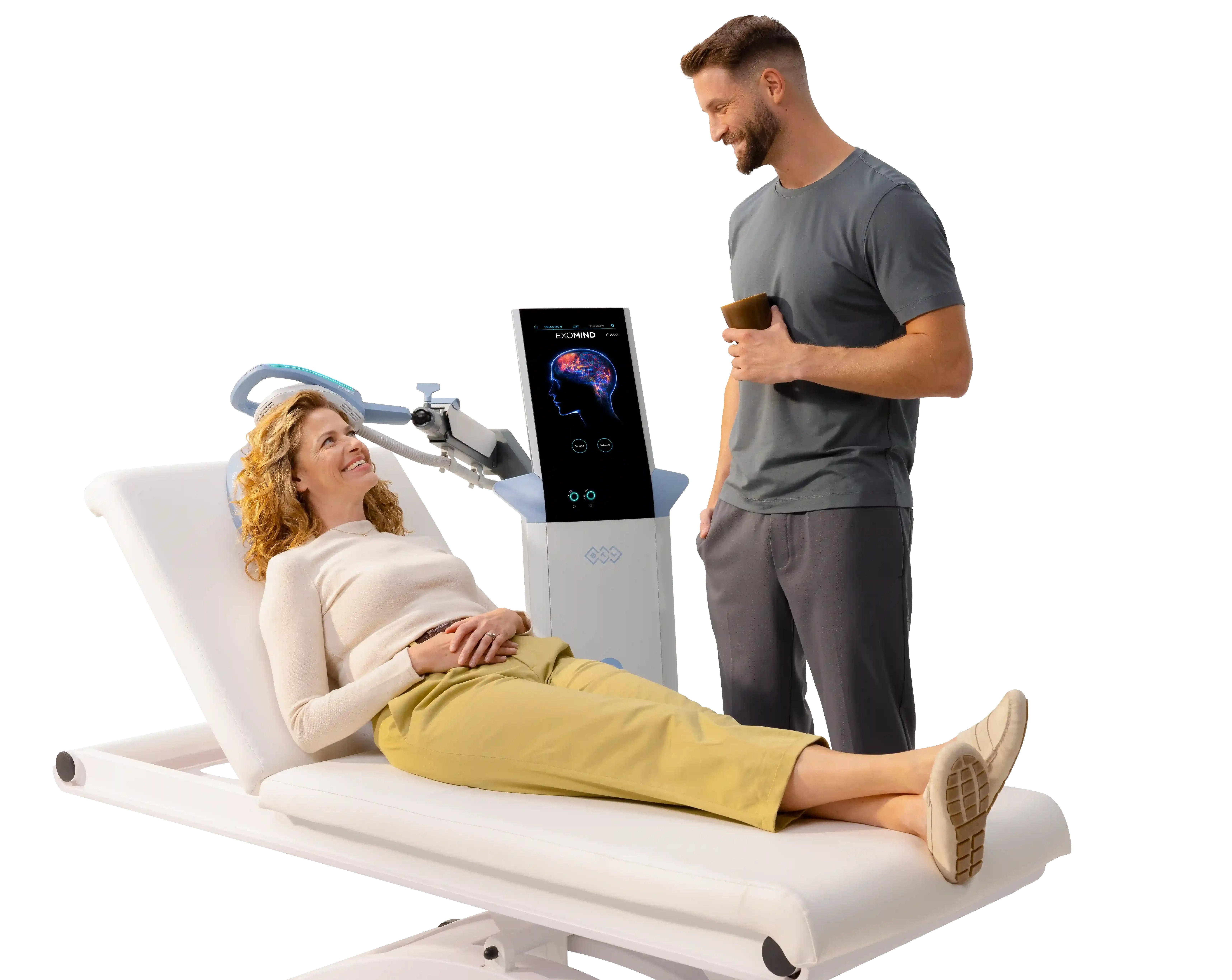
You sit in a comfortable reclining chair, fully awake, while the coil is positioned over a precisely mapped location on your scalp. You may hear a clicking sound and feel a tapping sensation during stimulation. Sessions typically last 19 minutes for intermittent theta burst (iTBS) protocols or 37 minutes for standard rTMS. There is no recovery time afterward.
Many patients begin to notice improvements in mood, energy, and sleep around the second to fourth week of treatment. Peak benefit is typically reached at or shortly after the 6-session course concludes. For traditional TMS, clinical studies show response rates of approximately 50 to 60 percent and remission rates of approximately 58 percent in patients with treatment-resistant depression. With Exomind, published data show response rates of approximately 80 percent and remission rates of approximately 58 percent in treatment-resistant depression, so patients can compare the two directly.
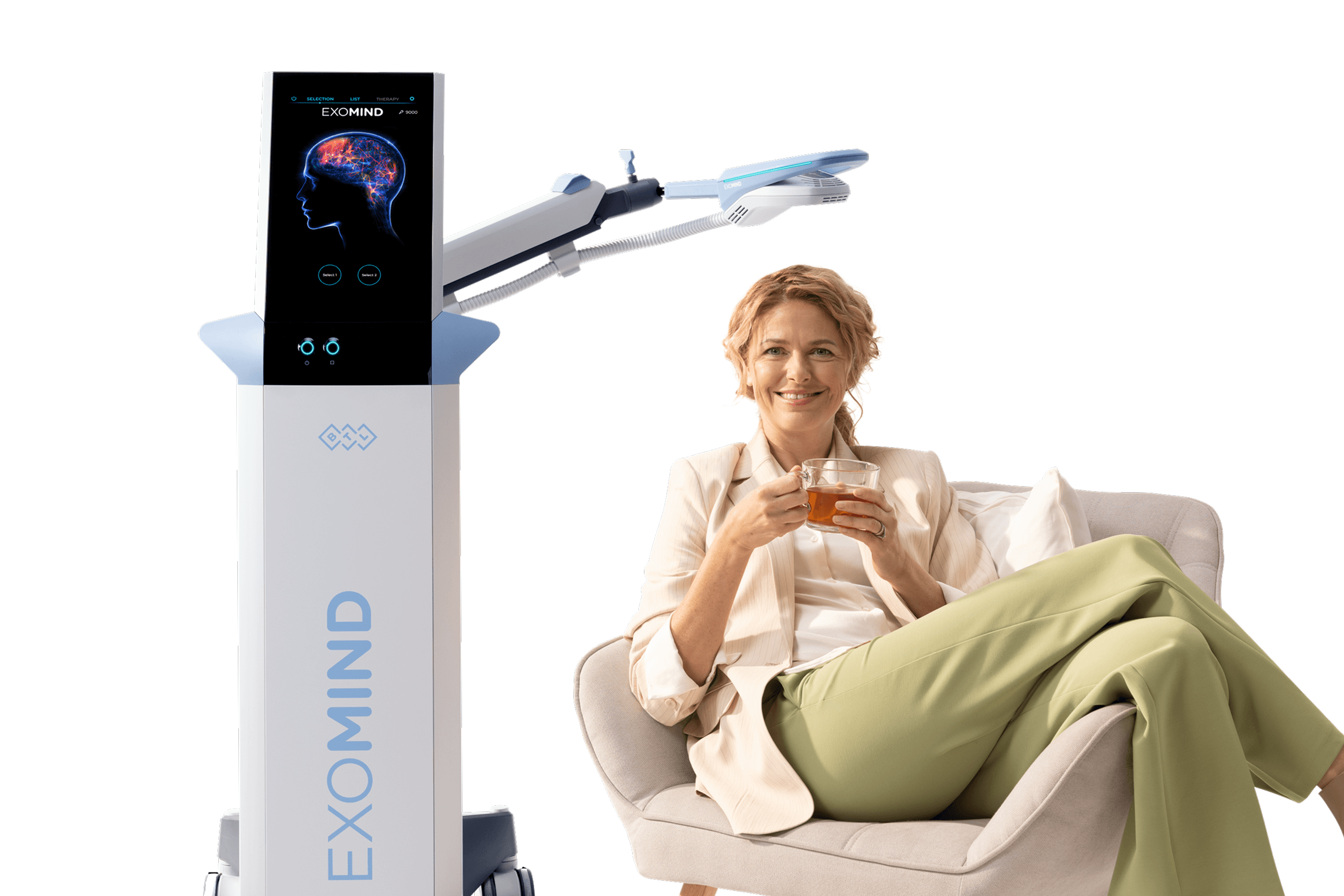
The Exomind device by BTL Aesthetics applies the same TMS technology to cognitive performance protocols, including focus support and cognitive maintenance, in addition to FDA-cleared psychiatric indications. Cleared and emerging applications are clearly distinguished during your evaluation so you understand exactly which use case applies to you.
Medication-Free Brain Stimulation
No anesthesia, no surgery, no sedation, no systemic medication needed
Unlike ECT, TMS does not cause memory or cognitive impairment
Drive yourself home and return to work or school the same day
Cleared for depression, OCD, and anxious depression with strong safety data
Exomind is self-pay. The Advance Care Card is accepted
Many patients sustain remission for 12 months or longer post-course
Compare Your Options
| Treatment | Mechanism | Time | Results | Duration | Downtime | Best For |
|---|---|---|---|---|---|---|
| TMS Therapy with Exomind | Focused magnetic pulses | ~25 min/session, 6 sessions in as few as 3 weeks | 50-60% response rate | 12+ months typical | None | Depression, OCD, focus |
| Traditional TMS | Focused magnetic pulses | 19-37 min/session, 36 sessions over ~6 weeks | 50-60% response rate | 12+ months typical | None | Depression, OCD |
| Antidepressant Medication | Systemic neurotransmitter modulation | Daily oral dose | 30-40% remission first try | Ongoing daily use | Side effects vary | First-line depression |
| Spravato (Esketamine) - not offered at our practice | NMDA receptor modulation | 2 hours in clinic | Rapid mood lift | Maintenance dosing | 2 hours observation | Treatment-resistant depression |
| Electroconvulsive Therapy (ECT) | Electrical seizure induction | 10 min plus recovery | 60-80% response rate | Maintenance often needed | Several hours with anesthesia | Severe, urgent depression |
| Psychotherapy | Talk-based behavioral change | 45-60 min/session | Gradual symptom relief | Skills last lifelong | None | Mild to moderate symptoms |

Finding Your Best Mental Wellness Path
TMS therapy is best suited to adults whose mood, OCD, or focus symptoms have not fully responded to first-line care, and who are medically cleared for magnetic stimulation. A complete psychiatric evaluation in Ashburn, VA and a current psychiatric medication management plan are required before starting a TMS course so that we have a baseline and can coordinate care.
Pregnancy is a relative consideration rather than an absolute contraindication, and your provider will discuss the latest evidence with you. If TMS is not the right fit, your psychiatrist will discuss alternatives including pelvic floor therapy with Emsella for related wellness goals or other psychiatric pathways.
Step-by-Step Process
Your provider positions the Exomind coil on a measured fabric cap to ensure precise targeting.
Your provider determines the lowest pulse strength that activates a thumb twitch to calibrate dosing.
You relax in a chair while the Exomind device delivers focused magnetic pulses for approximately 25 minutes.
Your provider checks on scalp sensation and tolerability and adjusts coil position if needed.
Your provider tracks symptom scores weekly and coordinates with your medication management plan.
What to Know
Mild scalp discomfort or tapping sensation at the coil site, mild headache, and transient facial muscle twitching are the most frequently reported side effects. These typically resolve within minutes to hours after a session and become less noticeable as the course progresses, often within the first one to two weeks.
The most serious potential complication is a TMS-induced seizure. The published incidence is below 0.1 percent per course, comparable to or lower than the seizure risk associated with many antidepressants. Hearing protection is provided for every session to protect against the brief audible click. There are no reports of long-term cognitive effects or memory loss with standard TMS protocols.
TMS has been FDA-cleared for major depressive disorder since 2008, for OCD since 2018, and for anxious depression more recently. Dr. Gonzales-Vigilar personally supervises motor threshold mapping, screens for contraindications including metal implants and seizure history, and reviews tolerability at each weekly check-in to keep the protocol both safe and effective.
Exomind is a self-pay service. We provide a clear per-session and full 6-session course estimate at your consultation. Several factors influence your individual cost: which protocol your provider selects (standard rTMS versus iTBS) and whether you require additional booster sessions. The Advance Care Card lets you spread out payments over as many as 15 months, interest-free, depending on credit. Exact pricing will be discussed during your consultation.
Loudoun County's Trusted Provider
Dr. Gonzales-Vigilar personally supervises every TMS protocol and monitors your symptom progress throughout the full course
TMS with Exomind is FDA-cleared for major depressive disorder since 2008 and for OCD since 2018 — with strong safety data
TMS is integrated alongside medication management and Genomind gene testing, not offered as a standalone service
Exomind is a straightforward self-pay service with clear per-session and full-course pricing provided at your consultation
Dr. Gonzales-Vigilar ensures every patient feels supported and understood throughout the six-week course
Reach the practice through the Valant patient portal with a 24 to 48 hour response window at any point during treatment
Pair TMS therapy with the rest of our integrative psychiatric and wellness care.
Your Questions Answered
TMS therapy is a non-invasive, FDA-cleared brain stimulation treatment that uses focused magnetic pulses to modulate the dorsolateral prefrontal cortex, supporting recovery from depression, OCD, and related conditions.
Yes. Across multiple meta-analyses, TMS therapy shows response rates of 50 to 60 percent and remission rates of 30 to 40 percent in treatment-resistant depression. OCD response rates are approximately 35 to 45 percent.
Exomind is a self-pay service with transparent pricing. We provide a clear per-session and full-course estimate at your consultation, and the Advance Care Card lets you spread payments over as many as 15 months, interest-free, depending on credit.
An Exomind course is 6 sessions, ideally spaced 3–7 days apart, completable in as few as 3 weeks. Some protocols allow for additional booster sessions if symptoms return.
TMS therapy is FDA-cleared for major depressive disorder, OCD, and anxious depression. It is also used to support cognitive performance with the Exomind protocol and may help with insomnia and brain fog.
Most patients describe a tapping or knocking sensation during sessions and possibly mild scalp tenderness afterward. There is no anesthesia and no recovery period needed.
Yes. Many patients continue their existing medication and psychotherapy during TMS. Our practice coordinates the full plan, including Genomind gene testing if appropriate.

